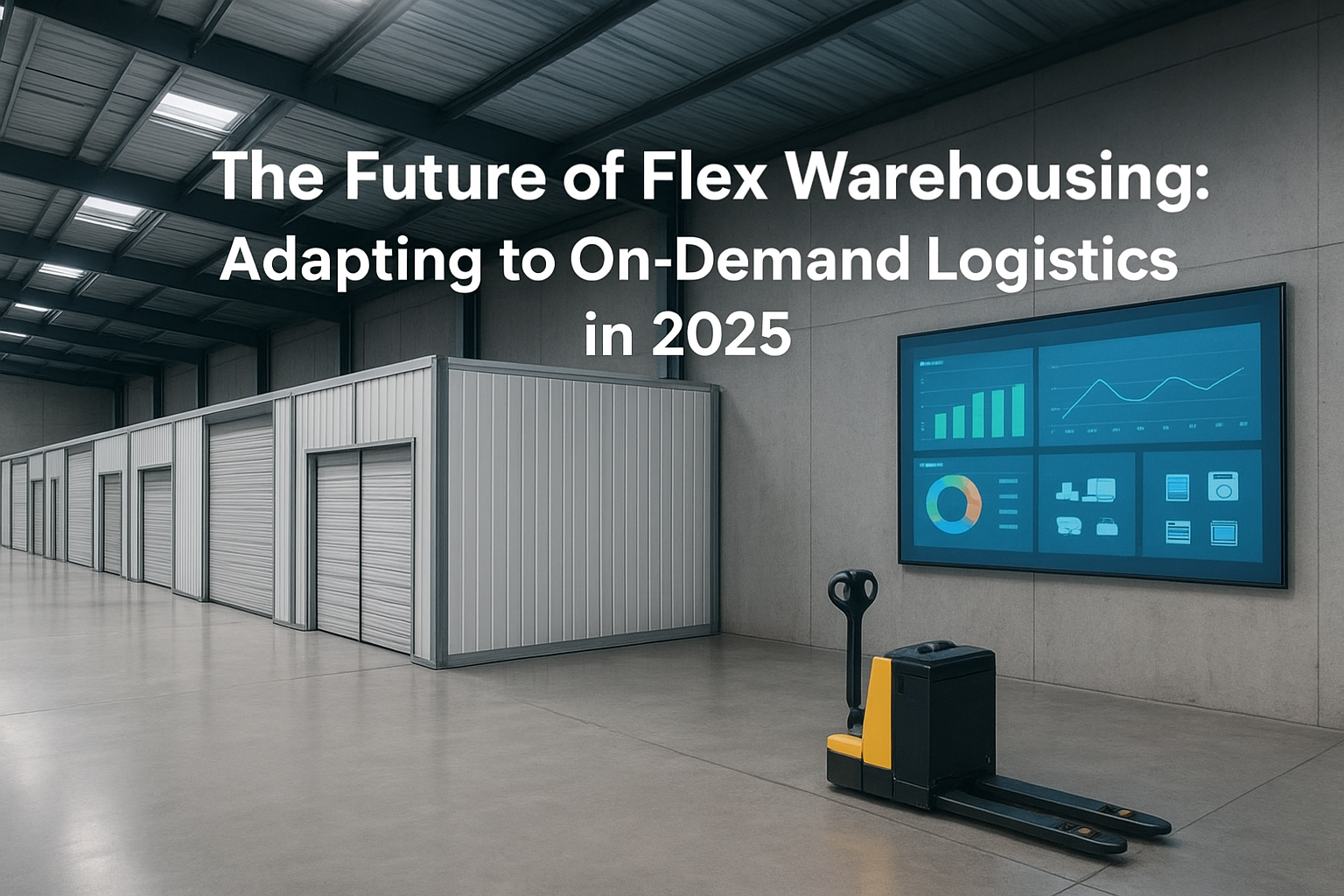
The Future of Flex Warehousing: Adapting to On-Demand Logistics in 2025
As we move further into 2025, industrial real estate is evolving faster than ever before. For small and mid-sized businesses, the concept of flex warehousing — short-term, scalable, and tech-enabled storage space — is transforming the way companies manage logistics, growth, and overhead.
Flex warehousing is more than a passing trend. It’s a reflection of how global commerce, technology, and customer expectations are converging to reshape the industrial property landscape.
What Is Flex Warehousing?
Flex warehousing allows businesses to lease warehouse or storage space on a flexible, short-term basis, often measured in months or even weeks rather than years. It’s designed for companies that need agility — scaling up during peak demand and scaling down during slower periods without being tied to a long-term contract.
Unlike traditional warehousing, which typically involves rigid leases and large footprints, flex warehousing gives businesses on-demand access to the exact amount of space they need, when they need it. This approach is especially valuable for:
E-commerce sellers managing seasonal inventory
Manufacturers testing new distribution models
3PL providers needing overflow storage
Startups and small distributors that value cost flexibility
In essence, flex warehousing brings a subscription-style model to industrial real estate — pay for what you use, when you use it.
Why It Matters for Small Businesses
For small businesses, every square foot — and every dollar — matters. Traditional warehouse leasing can be costly and inflexible, making it difficult to adjust to market changes. Flex warehousing offers a smarter alternative with benefits such as:
Lower risk: Avoid long-term commitments and large upfront costs.
Scalability: Expand or shrink space as business needs change.
Location access: Gain entry to strategic areas (urban centers, port regions, last-mile hubs).
Faster setup: Move in and start operating within days, not months.
This flexibility gives small operators the ability to compete on logistics efficiency with much larger organizations — a major advantage in the era of next-day delivery and fluctuating consumer demand.
Technology Is Driving the Shift
Technology is the backbone of the flex warehouse model. Modern logistics platforms and proptech innovations have made it possible to match available space with tenants in real time, manage short-term leases digitally, and optimize operations across multiple locations.
Key technologies fueling this shift include:
IoT sensors and smart inventory systems for real-time visibility into stock levels.
Cloud-based warehouse management systems (WMS) that allow shared or multi-tenant operations.
AI-driven forecasting that helps optimize space utilization and predict future demand.
Digital leasing platforms that automate agreements, payments, and renewals.
This seamless tech integration gives businesses not only space flexibility, but also data intelligence — insights that help reduce costs, improve efficiency, and increase customer satisfaction.
How Landlords Are Adapting
For industrial landlords and investors, flex warehousing represents both a challenge and an opportunity. Traditional leasing structures must evolve to accommodate shorter terms and higher tenant turnover, but the payoff can be significant.
Forward-thinking property owners are:
Redesigning facilities into modular or divisible spaces.
Partnering with logistics operators and 3PLs to create shared-use environments.
Offering plug-and-play spaces equipped with racking, office space, and digital systems.
Leveraging technology to manage multi-tenant properties more efficiently.
By adopting a flexible leasing approach, landlords can reduce vacancy risk and tap into a growing segment of the market — small and midsize businesses looking for adaptable space.
Emerging Markets for Flex Warehousing in 2025
While large metro areas continue to dominate the industrial landscape, smaller and secondary markets are quickly becoming hotspots for flex warehousing. These areas offer affordability, strong infrastructure, and proximity to major distribution routes.
Top regions to watch in 2025 include:
Dallas–Fort Worth, TX: Central hub for logistics and tech-enabled warehousing.
Phoenix, AZ & Las Vegas, NV: Growing as overflow markets for West Coast distribution.
Atlanta, GA: A thriving hub for e-commerce fulfillment and regional transport.
New Jersey & Inland Empire, CA: Strong demand for last-mile and near-port access.
With supply chain efficiency now a top business priority, location flexibility is emerging as a key competitive edge.
Looking Ahead: The Next Phase of Industrial Real Estate
The future of industrial real estate will be shaped by flexibility, technology, and sustainability. Businesses no longer view warehousing as a fixed cost — they see it as an adaptive resource.
In the coming years, expect to see:
More AI-powered warehouse matchmaking between tenants and available space.
Sustainable upgrades like solar roofs and energy-efficient infrastructure in flex facilities.
Hybrid leasing models combining long-term anchors with short-term users.
Growth of warehouse-as-a-service (WaaS) platforms simplifying access to space.